Showing posts with label Maasai Cow Project. Show all posts

Wednesday, July 14, 2010

Celebrating the Cow Project

Last Sunday we celebrated with some of the women who have received cows. We wish that all those of you who have given so generously could have been there too. We had friends with us though and Jenny received necklaces and thanks on your behalf.

Firstly we met under the tree with the church. For many of the women, it was the first time they had ‘sat in church’ and heard someone so clearly speaking from the Bible. It went from Norman in English, to Graham in Swahili to Nosikito in Maa and back again leaving plenty of time for thoughts to be gathered and words to sink in.


Then they all lined up to say thank you.


They sang.....


and danced......


and gave us gifts.


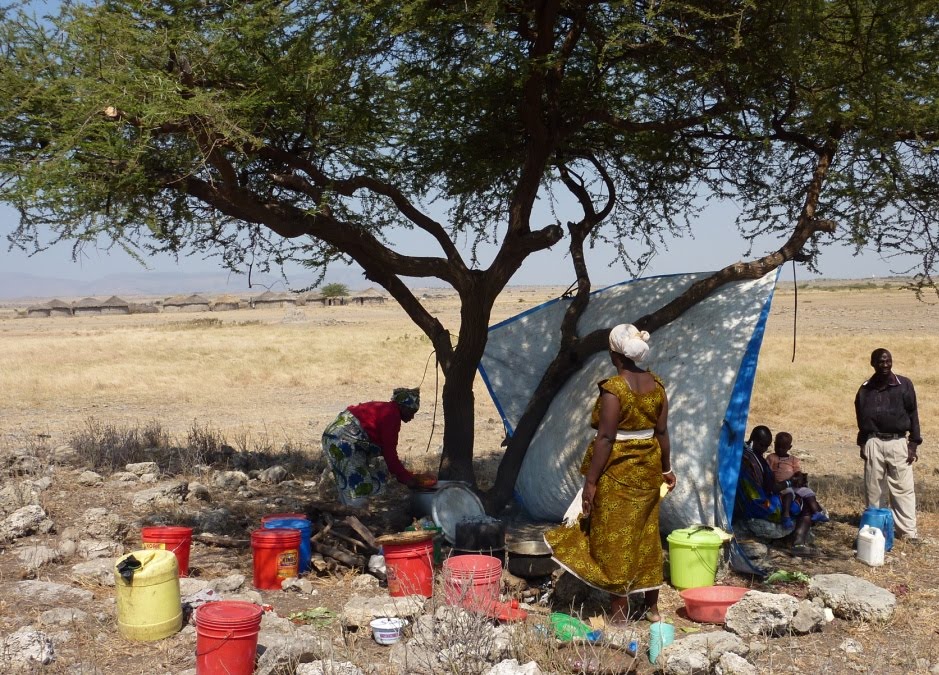
Meanwhile, two women from the local village were preparing a feast under a tree in very windy conditions so the singing and dancing went on...and on.....and on... while the flames under the cooking pots were encouraged to point in the right direction and do their job!


Sadly, we have lost 5 cows who had not re-gained enough strength after the drought to withstand sickness. The project rule is that the women have to present us with the skin that has the G stamped on it, then they go back on the list for a replacement – just once.

This is Simbavo showing us her skin. She was heart broken when it died and did everything she could to save it.

Saturday, March 6, 2010

18 More Women Have Cows!

Last week we gave out 18 cows. Some of them may still look very ‘scrawny’ to a European eye but all are in much better condition than when they left market in October. Although it is raining on and off in different areas there was not enough grass to sustain them all in one place. There were also reports of cattle rustling by some Kenyan Maasai who had sold their cows here at rock bottom prices during the drought. Most of our cows are Kenyan stock as they are an improved breed and give more milk.


Kivuya

So who are these women who have received a cow?

Several are widows with young children to care for. One has 7 married children but none are able to help her. Another is the second wife of a man who prefers his first wife...............


Ellena

Two or three have alcoholic husbands who are rarely at home and therefore unable to provide for their wives and children.

One has 3 married children but two are girls and husbands are often are unwilling to help their mothers in law as they consider the dowry to be enough help. Her son has married an ‘Mswahili’ (anyone who is not a Maasai) and has moved out of his culture.


Endoyekuna

One woman lost her husband when he went to market to sell a cow. Sadly he celebrated on the proceeds and was then run over by a car on the road home.

Another lost her husband to armed robbers who broke into the shop he was looking after for a friend. When her daughters were married, and she received the required number of cows as their dowry, a relative of her husband’s ‘ate’ them. She still has one younger unmarried daughter and is hoping the cow will give her a measure of independence from this relative and that she will be able to move out from under his ‘protection’.


Nanaito

This cow may not look like much of a gift and has not recovered as well as the others. It’s a start at least to help this couple get back on their feet as they have lost all their cows during the drought. They have two children and thankfully none of the problems common to the other women. We have no doubts that all these cows will be pampered and cared for extremely well.


Nanyoki

One woman has lost her husband and two sons to AIDS and is infected herself but keeps relatively healthy on ARVs. Another has lost 3 of her children and the 4th is unable to either work or look after himself, let alone her.

Yet another widow has two sons but sadly one is in prison and the other is an alcoholic. She is able to earn about £2 for delivering babies.


Grecie
The Maasai love any excuse to eat, drink, dance and sing and all these women are already looking forward to the moment when they can say thank you in this way- so are we!

Friday, January 22, 2010

On the Home Run

Early this morning, 28 very happy cows trotted off up our road beginning their journey home to Maasailand. They seemed to know exactly where they were going and took off at high speed with Penet and Balozi, their two herdsman, racing to catch up.


These cows were purchased 5 months ago at the height of the drought when the markets were full of cows being sold off while they still had some value left. We have kept them at home, feeding them and restoring them slowly to health.

Now they are on their way out to Maasailand where they will stay together until they are in calf and ready to be given out to women in the project. The distance by road is 100km, however they will go across country, munching and resting as they go, and will arrive in about 4 days time.

Times are changing - Penet and Balozi arrived to collect them with a phone each but no sign of a spear on either of them. We’re counting on the fact that most wild animals are well fed at the moment and won’t be looking out for a cow with a big ‘G’ stamped on its rump!


This is Balozi, Penet was running too fast to be able to get a clear photo of him!

Tuesday, October 27, 2009

We've been to market!

There is much in the news at the moment about the drought in East Africa and many people are indeed very hungry. For the Maasai, the drought has caused massive losses of their most valued asset – their cows. We hear stories of huge numbers of cows dying, of herds being reduced from hundreds to tens and of some bomas losing their entire herd. Outside most bomas there is a place where they are burning their dead.


One woman this week arrived on our door step having walked over 30 miles looking for food. Her husband has left her with their 6 children and all three of her cows have died.

It is raining in Arusha but the rains have not reached all the outlying areas yet and cows are still being sold for a song. Once the rains hit Maasaini – which we are hoping they will very soon - the prices will rocket with so few cows left in the economy. With this in mind, we have been to market – several times – and this herd of scrawny specimens is the result. They will take a long time to bring back to good condition and we are feeding them up slowly and carefully. Some will be ready to give sooner than others.


Today’s total is 23 enabled by supporters of this project.

Thursday, June 11, 2009

Branding cows at day break


I woke early enough to hear every rooster in Kikongoni crowing just as the sky was beginning to light up over the hills in the distance. Arriving at Ormondere’s boma, I found several women out milking and a couple of men standing wrapped up in their rubegas against the cold. Balozi and Lekoko, my two helpers, stumbled out of their houses muttering about ‘sweet sleep’, found the branding irons and we set off for Orlakaswai’s boma where the cows are kept. It was a cold clear morning.


There was no wood to be found so a fire was kindled using dried dung around which several young boys gathered to warm themselves while the men of the boma all stood wrapped in their blankets at the boma entrance and discussed the various cows that were to be branded.


As the small herd of youngstock, including our heifers, came within striking distance of the boma our animals were singled out. Stealing cows is still common and where people rely so much on income from their livestock, it’s vital to 'insure' their belongings by branding them.

When the irons were hot in the fire a heifer was taken by the head and the tail and with a twist of the head thrown onto the ground and pinned down by the neck with a hand inside its mouth firmly grasping the lower jaw. The back legs were then tied together and another person leant against the body holding the tail which was pulled up between the back legs.


The first marks were made under the eyes around the face and over the bridge of the nose. This caused the animal some pain and to distract it the person holding the tail would slap the sides of its stomach hard several times and say something comforting in Kimaasai.

I was trained in agriculture and enjoy sharing knowledge and insights into cattle and I have come to respect these people whose whole lives are based on their stock. It is amazing that from a very early age you can find small boys with a whispy stick herding flocks of goats and sheep in the middle of the bush. They have respect and care for their cattle and no fear although, from time to time people do get killed by their own animals.


Each of the animals received the marking of the Laiser clan. I had bought the right to use the Laiser brand from Ormondere, Nosikito’s father, for the price of a heifer. Thereafter he greets me by calling me ‘endaho’ (heifer) in Kimaasai and I, in turn, greet him the same way, showing that we have exchanged a significant present between ourselves and cemented a relationship.

As a final way of identifying the animals, they were all branded on the flank with a big ‘G’ to denote my ownership. This is done to deter the head of the boma, where the women are living, from selling the cows over their heads.


If a cow was a little frisky then a lassoo was made and hung along a stick and used to catch one of the back legs. Maasai always catch a cow by one of it back legs and then another man will pile in as soon as possible to catch the head and twist it around to put it on the ground. With bigger animals this can take some time and requires several people to join in until it is finally floored. One young heifer was very flighty and took off like a gazelle the minute it felt the rope around its leg. It jumped the thorn hedge and raced through the boma amongst the huts with a trail of young boys and murrans chasing it. It was quite a hew and cry until it was finally caught in the corner of the cattle kraal and dragged out to the branding area.


After the work, we drank chai and I paid off the young warrior from whom I had bought one of the heifers in the neighbouring boma. He had been forced to sell it as his young wife, the last of his late father’s nine wives in fact, had been in labour for four days. I increased the price of the heifer in order to help him out and agreed to give them a lift to the local hospital. He told me that she had been moved to another hospital and had successfully been delivered of a boy and that they were all home again and doing well.
As we left, the sun was well up and the main herd was making its way back from its early morning grazing towards the boma to be milked.

Thursday, May 21, 2009

Chai dilemma


With no prompting from any adults, these two little lads shared their chai, taking one sip each and then passing the cup to the other one. The dilemma now was – who was going to finish off the last little bit?

Wednesday, May 6, 2009

First calf


This woman was the youngest of her elderly husband’s 6 wives. After he had gone blind, she stayed with him and cared for him until his death. She now lives with her 6 children together with other widows in a boma ( a family homestead) of women and children. This was her first calf which was returned to the project and her cow is now in calf again.

Monday, May 4, 2009

An early morning lesson in dung


As I chatted to the women milking at dawn one day, I noticed a young woman begin to collect together the fresh dung left as the cows moved out of their night time kraal. I was intrigued to see her work on for more than an hour as the sun came up, collecting the dung in a bucket and dropping it into a large heap in the middle of the cattle enclosure, where she mixed it by hand at regular intervals. When she was satisfied with its consistency, she loaded it back into her bucket and hoisting it on her head, carried it, in several loads, over to the hut she shared with her mother, where she began to re-plaster the walls. What fascinated me was her composure as she carried out the work. From the outset, she was plagued by flies, on her hands, her head and face - she was pretty ‘plastered’ herself with the dung. It didn’t seem to bother her, she had a job to do, she asked for no help and made no complaint.
As a European, I thought of the hundreds of reasons why I would NOT enjoy such a job. In fact would I even think of doing it let alone enjoy it? I might get stuck in with a pair of Wellington boots, a long handled shovel and a wheel barrow and then use a VERY long handled trowel to do the plastering, but I can’t imagine just using my hands, hoisting the bucket onto my head and then plastering with hands that could now no longer be used to brush away the flies.
I was struck by how very pointless it is to worry about small irritations when you can do NOTHING about them. It seemed to me that this young woman had mastered the art of just getting on with a job that needed to be done, without bothering about the discomforts - and the reward? The very thing we all crave -absolute composure!

Sunday, May 3, 2009

Early morning chai


This little lad is one of the children who benefits from the Cow Project. His mother gave birth to him during the period when she was still feeding his elder sibling. Custom dictates that a man does not have sex with his wife while she is still breast feeding. He was subsequently rejected by his mother's husband and now lives happily with his grandmother. When he took the cup away from his mouth, his little face was nearly all white!

Saturday, May 2, 2009

Maasai Cow Project


One of the projects we run is the Maasai Cow Project. As traditionally nomadic pastoralists, cows are hugely important for the Maasai and milk is drunk in various forms daily. They often refer to milk as their 'vegetables' and when times are hard, a meal of maize porridge and milk will be considered a good one. We have particularly targeted the women who have no cows and little means of providing for themselves. Being entrusted with a cow of their own gives them status and a degree of self respect. Amongst those who have benefited so far is a grandmother who has the sole care of her grandson, a young single mother of two, a young widow with 6 children and two women whose husbands have sadly 'drunk' away the family goats and cows with 11 children between them.
Each woman receives a cow on ‘long-term loan’ so that it cannot be sold over her head. The head of the boma (a family homestead) can decide which cows to sell and when without reference to the the owner if she is a woman. Each of our cows has a large G stamped on its rump to indicate Graham's ownership. This has so far proved effective in safe guarding the cow. The first calf born is returned to the project and all further calves belong to the woman.
We hope to keep you updated with stories of some of these women with their names changed to respect their privacy.