Showing posts with label Safari stories. Show all posts

Saturday, June 4, 2011

Lost

Saigare was not at home. I half expected him not to be. It was late in the afternoon and his boma (group of family huts) was our last stop before heading home. I leaned on the bonnet of the Landrover and looked out over the dried up soda lake. He would definitely have to move again when the rains came as this would all be swamp. It was dry and dusty and even now I could only just make out the very top of Ol Donyo Lengai (Maasai Holy Mountain) in the distance as a huge dust cloud had been whipped up by the wind and was advancing like a curtain across the mountains in the distance.


I could feel a fresh breeze in my face so we turned around and headed off into the scrub. I was the only Mzungu (European) in the group with Maiko and Lekoko, both Maasai, and Geti, a Mwaarusha. We had had a long day distributing food and I was hoping to find the track that would lead us safely back to the tarmac road. Somehow, in my mind I had an idea that it would all be quite straightforward and simple. I was looking forward to being back with Lisa, anticipating telling her of the day’s events and all the people we had met.

I began to get annoyed when I couldn’t find the track nor could I recognise the korongos (gorges) we were crossing. The sun had lost its strength by now and was heading for the horizon and I knew it would be a whole new world out there in the dark. Despite my anxiety Maiko was cheerful and had already worked out how we could spend the night in the back of the pickup. Maasai are quite used to sharing a bed with their own age set but I was thinking that I’d rather drive all night!

I took out my new GPS and looked up the tracks that I had stored . It was blank, not a single track. I then realised that I must have deleted the whole memory when I thought I was deleting a single track. Now I was not only anxious but really annoyed, partly for the inconvenience but also for the loss of the log of a long and strenuous track that had disappeared into the ether. I decided never to rely on modern technology.


I decided to follow the advice of those ‘what-to-do-when you’re-lost’ books and ‘traverse the terrain’ hoping to cross a track, any track would do. When we arrived at the top of a hill that I thought I knew, I found I was in fact looking across a huge gorge straight at the very hill I should have been on. Now I was dismayed and disorientated and the sun was minutes away from the horizon.


Someone saw a herd of cattle behind us so we turned hoping to get some local advice but we came again to the edge of an enormous gorge. Everyone got out and wandered down to the bottom to see if there was any way across. I sat in the Landrover and tried to ring Lisa but there was no signal. We obviously weren’t going to be getting back in good time. My hopes of a light supper and an evening with my wife were fading and I was more than a little irritated. I asked God for ‘just a track,’ thinking that our problems would be solved once we were on the right path as all tracks eventually lead to the main road.

I picked my way rather bolshily amongst black volcanic boulders, anticipating a struggle to cross the gorge but as we crested the opposite bank I was surprised at how easy it had been. I presumed God might want thanking for that, but we were still a long way from home so said nothing.

The herd of cows turned out to be a flock of goats and sheep and were standing outside a boma being milked. I anticipated coming across a simple lad with a scraggy herd, madly driving them home before dark but instead we were greeted by a short weather beaten man whose wives and small children slowly emerged from their huts shy and smiling. The older boys greeted me in Swahili but the women only spoke Maa. He said he would show us a track that was not far from the boma and we gave him some of the remaining food we had to distribute. The women laughed in delight that food had come to them all the way out there, free and in the dark! I was glad that we could help them and relieved that we had found some reliable advice. I noted the man’s name in my GPS tracklog, so that I could visit him again (hopefully).


His sons ran ahead in the headlights, barely discernable in the dark and I tried to follow all the gesticulated instructions. However we arrived at a small gorge that was impassable with huge boulders strewn inconveniently all over the place. The man and his sons then rushed about in the dark finding another way across. Maiko commented on how bright the boys were, how they had understood the problem and immediately worked out another solution. I sat quietly repenting of my assumptions and thanked God for the track and that we were now ‘on our way.’


We wound our way upwards in the dark, weaving this way and then that. The track was so unclear that I wondered how they had made it in the first place. What a contrast between Roman and African ways – one militaristic and straightforward, the other social and circuitous.

I was trying to plot where we were in my mind as we were in total darkness now. When we came to a fork in the track the popular vote was to go right. However, after a while I stopped and turned off all the lights. It looked like we were heading around the back of the only visible landmark which was the looming mass of Lepurko mountain straight ahead of us. So we retraced our tracks and headed off to the left. It was an old track that was very overgrown with Acacia scrub and took us away from the mountain. This fact worried me as by my reckoning we should have been amongst tall acacias on flat ground and skirting around the mountain.

Maiko kept reassuring us that he was born in a boma just over the hill and knew the area well. So we drove on. We could see torch lights shining on the dark mountainside behind us and wondered if we were being ‘advised’ or were they cattle herders just going home late? There definitely should have been a hunter’s camp on a ridge to our left at some point. When we stopped again and switched off the lights we couldn’t hear any sound and the only torches were from a boma a long way off. We were miles from anywhere and totally lost.

‘Barabara’ is an odd sounding word. It is Swahili for road and when the ‘barabara’ suddenly dived into another gorge and didn’t come out I was convinced that we should turn back and take the right fork. We retraced our tracks again and all I could hear was people muttering about the ‘barabara;’ with a barabara here and a barabara there, old Makofia lost his way, aiyee, aiyee, oh I think I’m going mad! I shook my head to concentrate on the faint tracks in the light ahead of me.

This time the track took us winding round and up and down until it finally came onto a bit that I thought I recognised. Hopes were up until it then went up hill sharply and divided into two, which totally exasperated me. We took the left hand one and followed it round a large tree and there in the headlights was a neat little footpath. We had driven straight into the hunter’s camp and had arrived in ‘reception!’ There was a stunned silence as everyone recalibrated their mental map of where we were.

Several men came out of the darkness with powerful torches bearing spears and interviewed us. Yes they had been shining a torch at us earlier on knowing we were heading up a blind ‘barabara’. Happily they recognised me and gave us instructions for the right road and we were on our way again. We were all tired and I was frustrated so when we took another wrong turn there was a tense debate. It was implied that I hadn’t understood the man’s Swahili instructions. ‘But,’ I said, ‘two lefts don’t make a right. We went wrong on the first track and took a left and then we should have taken a right turn to get back onto the original track. Now we have taken another left so we are doubly wrong.’ There was a moment’s silence and then they were amazed at how stupid the young man had been in telling us to go left. I smiled at the deft avoidance of loss of face. This time we were on the right barabara and I recognised it.


There was phone signal and the distant glow of civilisation over the horizon. I told Lisa that we would be a little late as we had got lost but now we were on our way. She said she might be up when I got back. Well thank you, I thought to myself, you have no idea where we have been…but then I don’t think anyone else had either, except maybe a few bemused locals who had been watching our headlights erratically traversing the bush for the past few hours.

Sunday, April 3, 2011

The 'Seven Stepper'

On a recent trip, I had an interesting snake encounter. I was waiting for the guys I was with to get back into the pickup when I looked out of the passenger window. There on the grass only a few feet away was an enormous black mamba, looking very calm, coiled in a lazy circle with its head held up in the centre.

I recognised it at once by its supercilious smile as it carefully surveyed the scene. I shouted that there was a ‘really bad’ snake and everyone should get into the pickup. Just as I thought I should take a photo it started to slither into a hole in a dead tree trunk whilst its tail began to thrash around angrily.


I wondered what would happen next. Then we saw that there was a herd of cattle coming through the trees towards us. Someone shouted at the moran herders to warn them. Straight away they came towards us picking up small rocks and circling warily round the dead tree trunk. Then the one nearest the car saw the head appear out of the hole and start to go for him. He immediately chopped down onto the snake’s back with his long-bladed spear. The snake started to writhe around and I saw the spear was bent so he quickly changed to using his herding stick.


(What I particularly love about this photo is that he kept hold of his umbrella, spear and water bottle in the other hand throughout the process! That’s one cool warrior in my book!)


The other moran came from the other direction and joined the fray.


It was all over in a very short time and the snake was lifted into the air and displayed as truly dead. It was about 7 feet long and about 3-4 inches across at its thickest!


We left them to hoist the body into a tree for the birds and drove on with many excited comments about mambas. The immediate instinct here is to kill snakes whether they are venomous or not. We often find ourselves defending them and begging people to leave them be, especially if they are obviously completely harmless like a common house snake. However, this one was a killer and could have attacked the herd of cattle so I left them to do what they had to do. The snake had seemed oddly calm to start with and the others thought that it had eaten something recently. However, it was definitely angry and coming towards the moran when he struck it.

They call the black mamba ‘the seven step snake’ as the poison is so potent that you only have seven steps of life left. They are also very quick and aggressive snakes and can bite repeatedly, easily able to kill several full grown cattle in one attack.

Then the stories started......a man in South Africa had driven over one and it had caught onto the chassis of the car and held on to the running board until he reached his hotel. As he got out of the car it bit him and he died.....

And a friend, driving along in his pick up full of people, stopped to look at one on the side of the road. It went for them, the passengers leapt up onto the roof bars, our friend slammed the cab window shut, the black mamba slithered up under the bonnet and they had no choice but to continue their journey. Upon arrival, they gathered round the car armed with sticks, lifted the bonnet carefully with a VERY long stick and there it was curled up on the engine!

Monday, January 31, 2011

The Three Calf Bet

After a recent trip to a new place and a new challenge Graham writes of his drive home:

As we packed up camp we began discussing the way back. Apparently there was an old road down the other side of the mountain that would save about 5 or 6 hours driving time – a very tempting idea.

A young moran came and asked us to take a very sick old man down to hospital. I asked him if we were going this ‘quicker’ way would he still want us to take the old man. He said he would which I took to mean that the road wasn’t bad enough to be a risk to his life. We found him lying in an old boma next to the road after an hour’s driving – he was not well at all and was in considerable pain all over. We took out our mattresses and made a bed for him with a couple of bolsters so that he was sitting in the back like a king.

Many of the young moran on the road warned us that we would never make it through the road ahead. Not even a motorbike could get through now they said as it was washed away. In the end, I bet a particularly fervent young moran a calf that we could get through. Two others said that they would also bet a calf, making the prize for success three calves. Always glad of a challenge I accepted although secretly I did wonder......


The road looked deceptively harmless but vegetation disguised deep gullies and sudden drops where the road had washed out. Our first problem was a washout in the middle of the track bound by hedges on either side blocking all other options. We dug and filled holes and tried it. The ground started to collapse as I drove across the gulley and I had to reverse quickly. I wondered again if this was stupid but also thought we may have reached the point of no return already. A couple working in the fields nearby helped us and warned us it was much worse ahead but as we got through I felt more encouraged.

The dirt track now turned into a very rough rocky road and sloped steeply downwards. We walked the track and worked out a route, filled holes and moved the larger rocks. I was now quite calm about us going on and looking forward to the three calves. We wobbled and lurched down the hill, filling holes in on the way with one man guiding me from in front and another organising passers by to help.


Round a couple of bends we came across a huge problem where the road had been washed right out with a twenty foot fall onto some large boulders below. The only viable option was to cut a deep ditch out of the hillside above that the top tyres would lock into and stop the car from slipping away. The work progressed slowly as the slope was pretty steep but a woman kindly cooked chai for us to keep us going.


No one else seemed to understand the physics of Landrovers and there was a fair amount of goading to try this and that but I had the upper hand as the vehicle was mine and I was behind the wheel! We carried on with much banter, exhortations and heavy sweating.

After several failed and rather alarming attempts, I tried again but needed people to push the back end up hill. Many refused as they thought that they would be squashed if it rolled. However, I managed to encourage enough to push with others sitting on the topside of the pickup. Now the rear tyre was in the ditch and things looked good, but when they told me to keep going beyond where they had dug, it all went pear-shaped again and I ended up at a precarious angle just above the washout, holding onto the passenger’s side doorpost to keep myself on a level!

(No photo of this bit as I was holding on for dear life!)

More digging and the afternoon wore on. It took a lot of leading by example to persuade those who were flagging to keep digging as we were all pretty exhausted. My fear was that the last few metres would be too steep and as I was turning down the slope to rejoin the road the Landrover would tip over. And in fact, as I rushed down towards the road the topside front wheel started to lift and was only just stopped by the other front wheel meeting the flat surface of the road and pushing the vehicle level again. The spring gave a loud bang as it bent back into shape which made it all the more dramatic.

Everyone was happy and after all that were saying how easy it had been! I think I was the only one who knew how dodgy it had really been.

We now had a pickup full of people wanting a lift to the next village which was useful when we met the next obstacle which was a very deep but narrow washout that someone had carefully camouflaged with sticks - and I drove straight into it! Luckily only the front driver’s side wheel had gone in but there wasn’t much to stop the car going on down the gulley. With plenty of help on board, the front of the vehicle was lifted out and we were soon well on our way again.

THEN the two morani who were accompanying the old man told us that the track had been cursed by the witch doctors so that strangers wouldn’t have access to their land – now they told me! I’m happy to say that despite it all, the old man arrived safely at a better hospital at the end of this road than he would have done at the end of the longer road.


The views across the plains were spectacular. Sometimes I look at views like these and get butterflies in my stomach. The grand scale of the wilderness with no sign of man. Below us the biscuit brown plains stretched away into the distance, broken up with big seas of yellow grass. To the left were a line of progressively smaller rounded hills, swooping down from the heights of a nearby mountain, each one haloed in a dust haze. It was a magical light show of both detail and grandeur with so many hues blended into one great tapestry that was a feast for the eyes and refreshed the soul.

Thursday, December 2, 2010

Visiting Nomadic Friends

A trip to visit three different people – something that would seem to be relatively simple. But things rarely go according to plan here. All three men have moved with their families, chasing what little grass there is left until the short rains come.

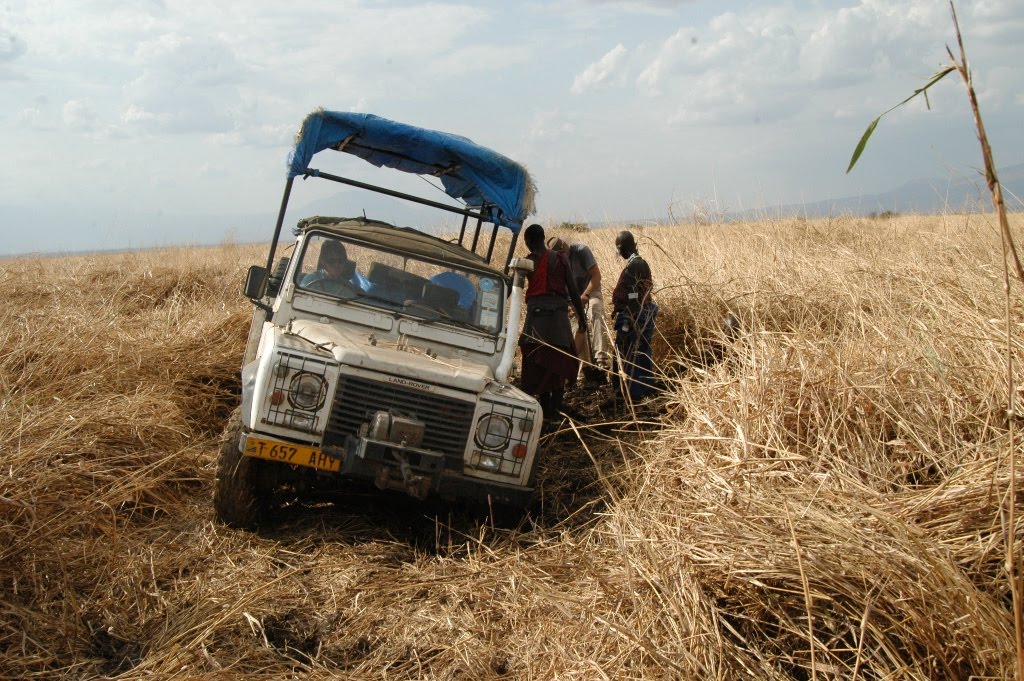
On the way to find the first man, we get stuck in a bog. Everywhere is dry, dry, dry and the bogs are a complete surprise.


It takes three hours to dig, get out onto dry land, fall in another bog, dig, get out, fall in another one, scratch our heads, sweat, drink bottles and bottles of water, pray and call friends in Arusha to add their prayers to ours and finally to get clear of the hidden bogs.

As evening draws closer, and it’s obvious that we will have to pitch camp soon, we find where our man is now living. But - his boma is just OVER THERE!


Even our guide can do nothing but squat and look in despair across the gorge. He has never been there on four wheels before!


Only one thing for it, clear the rocks and make a way through. And thankfully by then our hosts have come to meet us and are as determined as we are to get us there.


We pitch camp just as the sun is setting over the Rift Valley Wall in the distance – a sight to refresh us in our weariness. The warm welcome we receive also dispels the frustrations of the journey.


Next day more head scratching after several attempts to climb back up the side of the gorge we had come down the previous evening. More heaving of rocks and the day begins with sweating again...... and an hour later, after more prayer, we make it out.


The second man, when we find his new boma, is not there of course because we have wasted precious time getting out of the gorge. He has already gone off with his cows. At midday we find him and he is delighted to see us. No means of communication with anyone in advance.

The third man has moved too and we have run out of time to find him. We have to build a stone bridge to get to his boma – that we find he has moved from -because water has gone through since we last used this road and made a gully that is just a little bit too deep.


By this time, we have a sick baby on board and the road out to the nearest doctor and cold soda is the only way!

Saturday, July 24, 2010

Living Water

As I sat listening to a friend speaking about the Living Water out in Maasailand, I looked down at my feet...


which had looked like this two hours earlier when I left home.


Then I looked at the people around me, everyone of them dusty and dirty...


and I wondered how people who live in constant dust would understand the concept of the Living Water, of cleanliness, and what’s more, inner cleanliness that lasts for ever!

The talk was inspired by the morning’s water run – a diverse experience as men, women, children and animals all partook of the same rather brown water.

One washed his clothes with the help of his shoe.... (if you’re wondering what is in his ear, it’s likely to be a film canister carrying his snuff. The large loops in people’s ear lobes are used to carry all sorts of very useful things.)


And then everyone dipped in.........


And finally all the containers had to go back in upright, together with all the women..........for the 6km return trip.


And in the end, after all that, not only did the water inspire the message, but the water containers were then used as the ‘pulpit'!

Friday, February 26, 2010

Eco Lawn Mowers


Graham often arrives home with a ‘thank you’ from Maasaini. The goats are sent straight on elsewhere as they have absolutely no appreciation of a carefully laid out garden and can wreak havoc in no time at all. This flock of ‘lawn mowers’, on the other hand, can be left to graze happily and are a very pleasant addition to our environment.

Thursday, February 18, 2010

Dust storms, Rain and 'Dry' Riverbeds!

Last week’s trip was primarily about preparing the first demo plot for Foundation Farming. As always though, the trip was about several things at once.

Alima is a young girl who sustained terrible burns to one eye and ear and was brought into town for plastic surgery last year. Last week we returned her home after 4 months in rehab.


Graham writes: Alima was in the front with me and we got on well, despite her not having very coherent thoughts in Maasai and me trying to speak coherently in Swahili. She had a very engaging way of looking at me from the corner of her one eye, giggling and trying to explain some complicated thought in Maasai with lots of gesticulations. Then she would stop and check and if I looked totally perplexed she would throw her head into her lap, grasp the back of her head and roar with laughter at my incredible stupidity.


Taking Alima home proved a more interesting exercise than anticipated as Graham became engulfed in a twilight shroud of dust masking all known landmarks and trees and causing him to drive round and round and round............until the very man he was looking for came flying out of the dust – ‘in the middle of nowhere’! He had been watching their progress and running around after them trying to get their attention!


This Koko (seen here in happier times) was knocked over by a dust devil outside her hut two weeks ago resulting in terrible pain in her hip. She had not walked since and had been waiting for ‘Olais’ (Graham) to come and rescue her.


Her idea was that she would go home with him until she was better. There was much discussion in the boma - and with a doctor over the phone - and in the end it was decided that she would improve with the help of painkillers which her grandson was to fetch for her. However, Koko had set her heart on going back with the ‘Mzungu’ so she threatened to curse them all, saying that her boma had cows, sheep and goats and there was no reason why they couldn’t afford to take her to hospital. It is very hard to discern the truth in situations like this. ‘Olais’ was adopted by this koko when he came across her lying under a tree in the ‘middle of nowhere’ unable to walk home from hospital. Everyone in her boma was very alarmed by her threats but in the end a good night’s sleep, with the benefit of strong painkillers, convinced her of the merits of the plan.

Other highlights of the trip were:

• Getting thoroughly stuck in a ‘dry’ river bed after a rain storm - thankfully near a boma where the women folk cooked tea while the men did the digging

• Distributing 520 donated mosquito nets on behalf of the leadership of two villages who had no vehicle to do so.

• Taking a young boy with a four year old growth on his foot to see a doctor along with a man with scabies who had been treating it with battery acid! He was not a pretty sight and too unpleasant even to describe.

• Giving out food and identifying four more women needing cows.


The question on people’s lips seemed to be ‘Who brings this Mzungu? Why does he keep appearing out of the dust or the rain storm to help us?’ An opening we are very glad of..................

Wednesday, October 7, 2009

Graham and Norman's August safari

Graham writes: We started the safari buying some Kenyan cows for the project – better stock and one a young bull calf for breeding purposes. The man was quite reticent but when we started bargaining he came alive, like most Maasai do, to extol the virtues of his cows and why they should be such a high price!
We put our usual marks on the animals that we had bought - the Laiser clan markings across the face and the Big ‘G’ on the rump.


We drove up the Rift Valley and cut across country into the dust.


As we drove near one boma, a young man and a load of children ran out begging for water. Their womenfolk had gone off in the morning and not yet returned. It was after 4 pm and they had had no water. Most of them had been sleeping to pass time and conserve energy. Lekoko opened up the maize sack and gave them some - about 40 kilos - and then gave them water which was gulped straight down.
Everyone was happy and waved us off thanking us and God profusely. It must have been so unreal for them that a couple of white men would come over the hill with food and water out of nowhere. We were to experience this again in several other places.


As the light was fading on that first night, we set off towards Saigare’s boma with him showing us the way. He began to take us through trees and dry river beds while he and Lekoko ran ahead in the headlights to make sure that the Land Rover could get through. A man who is used to walking everywhere and doesn’t know how to drive isn’t the best person to choose the path ahead in my experience! It was incredibly dry and dusty with a terrible following wind that obliterated everything from time to time.
In the end even Saigare lost his way home and asked us to stop and turn the headlights off. Way behind us we could see a dim torch light which was the boma signalling to us that we had passed so we did an about turn and found them. It is a ronjo boma - a dry season temporary boma - made up of a thorn fence and huts of leafy twigs through which the wind and dust blew mercilessly.


Luckily we were given a sheltered spot behind one of these with a couple of cowhides on which to put our mattresses.
Despite the late hour Saigare wanted to kill a goat for us. We had fallen asleep when someone came round with the liver so we chewed briefly through it with our host. We slept again and were woken up a second time for the meat! Sleep was again interrupted when some moran (warriors) came to the camp late and woke up the woman in the ‘hut’ right next to our heads asking for chai. They talked and joked whilst it was being prepared and drunk. There is no whispering in Maasai except to tell secrets it seems. Apart from that we only heard the laboured breathing of a baby with a bad cold!


The dawn was a wonderful display of light and warmth, although I tried hard to keep my eyes closed and catch up on my sleep. When I did open them I found an audience of four women standing watching me!


I soon forgave them when I had a cup of hot chai in my hand, which I make a habit of sharing with the children so we had an attendant flock of eager-eyed young ones. One of them was told to greet us and then between deep shy gasps gave us all the news of the boma, just as a grown man would do, whilst his father watched proudly in the background!


Next stop was the wells where they water their cows. The wind was still blowing relentlessly whipping up clouds of dust as the various flocks headed off in search of patches of grass to eat. The cows are being hit hardest as they need grass whereas the goats can graze on young leaves off the trees. We came across dead cows along the cow trails in many places.


It is reputed that the British dug the first wells to help the Maasai who have continued digging them since then. Each one is variously owned by a group of men with bomas and flocks in the vicinity. There is a small group of young men from other tribes who live and work here doing all the digging on contract. Saigare’s well had run out of water the night before so he had asked to water his cows at a neighbour’s well. He waters the cows in the evening and the goats and sheep in the morning. The water is thrown up in a half galloni - about 10 litres - in three hands up to the trough where the animals come down a path to drink.


Saigare showed us the skull of a hyena he had killed. It had large heavy incisors a couple of flat topped teeth and the back teeth which should have been molars were incredibly sharp and long single teeth. He took us to where he had tied up a piece of cow hide through which he had threaded two sharp sticks with meat on. Directly below it he had dug a stake into the ground and tied his sime (bushknife) to it pointing upwards. The hyena had come along and jumped up for the meat and come down right on top of the sime. Suddenly Saigare was grunting fiercely and running backwards and forwards waving his stick and sime agressively. He was apparently showing us how he saw off a lion that had come after his goats - very impressive show of psychological testosterone! I’ve often wondered what I would do if I met a lion. Statistically it has to happen at some stage if I keep going out into the bush.


We set off again through blinding sand finding a new way through the scrub. We had just cleared the thick scrub when the exhaust came apart and the engine started to roar so we made for a tree and cooked up some tea. I managed to make something up from a tree root and with Lekoko’s help we tied it in place - it lasted until I fixed the thing properly a week later!


At our final stop we found it was market day and as we were desperate for some water and to have a good wash we also headed for the water trough. We stayed again in Norikito’s boma in a hut that was partially built and very comfortable.


Jenny and Lisa joined us here and arrived just in time to dance with the women whilst the men slaughtered the goat under a tree out of sight of the boma - morans (warriors) can’t eat meat that has been seen by a woman.
We were given a portion that we set out on some leaves and sat and ate with the men of the surrounding bomas. It was very tender and we all relaxed and enjoyed it.